Benefits Of Stationing

Benefits Of Stationing

Benefits Of Stationing

Nervous dog? Excitable Dog? Reactive Dog?

Stationing is when we ask our dog to get onto a thing and stay there for a period of time. Typically we ask for four paws up, but this can be done with two paws up, a down, a sit, or whatever is most useful for you and your dog.  We use this a lot for dogs who need help being calm, confident, or focused while out in the world or when a lot is going on around them.

Teach it at home first. As your dog to climb onto as many surfaces as you can think of: a pillow, a couch cushion, a coffee table, an upside down pot, an upside down laundry basket, a planter.. you get the idea.  You can lure your dog with cookies or shape it if you prefer to train that way.  It is important that you don’t pull, push, or place your dog on the item though – the whole point of this game is for them to learn to climb on themselves. Pay them well! (Many Cookies)


Environmentally Sensitive Dogs

Riker and Jubilee are both anxious in new buildings. Riker is a nervous guy all around and Jubilee, well I’m fairly sure she is worried that every inside place is another vet’s office. Unfortunately she has had way too many vet visits and is very anxious about the handling that occurs there.  For these two dogs, we practice stationing, a strongly reinforced (lots of cookies) and predictable behaviour, in many different situations. 

A go-to behaviour with a high rate of reinforcement takes their minds off of the ‘what ifs’ and teaches them that these uncertain areas predict fun things happening.

With enough practice, they will hopefully learn to look forward to heading to unfamiliar places as, more often than not, fun things happen there.

Look for different surfaces and textures. Frankie is practicing on rounded metal pipes!

Why Station?

Build confidence in new or scary locations

Keep your dog out from underfoot

Distract your dog from things they may bark at

Build body awareness and confidence.

Give your dog structure so they can let go of being ‘On Guard’ when people or other dogs are nearby.

Gives your dog an easy ‘out’, an easy thing they can do rather than worry about things going on around them.

‘Choice’ Moments and ‘No Choice’ Moments

‘Choice’ Moments and ‘No Choice’ Moments

‘Choice’ Moments and ‘No Choice’ Moments

Dogs do, or should, have ‘Choice’ moments and ‘No Choice’ moments. Both are important.


‘Choice’ moments are when we ask our dog to do something, and they can say ‘No’. 

An example is when working with a reactive or overexcited dog.  Assuming that at home or when there are no big distractions nearby, a dog can sit, then sitting near other dogs (if that is what they react to) is a ‘choice’ moment.  If I ask a dog to sit with a scary or exciting dog nearby and they can’t, this is information. We may try an easier task like a cookie scatter, or we might move away and try with more distance.

I could coerce or force the sit & many people do!  By using force or coercion, we ignore the animals emotional state.  I often get calls about dogs who ‘seem fine, then explode’, this is often seen in the dogs who were trying to communicate that they can’t sit.   As a side note, coercion doesn’t always mean force. Cookies can be used coercively too!


& ‘No Choice’ moments are when we need our dog to do something, and saying ‘No’ is not an option for them. 

Ideally, we do this as little as possible, but life has no choice times for us all.  Barking and lunging at people or dogs is one example of a ‘No Choice’ time. It’s NOT ok to bark and lunge at people or dogs while out on walks. If I am training a dog and they start to back and lunge or I can see they are about to, we are walking away. Period. No choice is available.   If the dog is capable of responding to cues at that time, I’ll call away or even lure away with a cookie as it is less aversive and will entwine less ‘icky’ feelings into the scenario.  However, if the dog isn’t likely to be able to respond, I won’t ask and we are still leaving. Standing there waving cookies in a dogs face while they terrorize people at the park isn’t an option that I am willing to entertain. I simply shorten up the leash, and off we go.. I’m going, and the pooch is attached to me via the leash, so they are coming too!   I’m not angry or punitive, just simply and matter-of-factly leaving and taking the dog too.


Another, less obvious is getting into the car at the end of a hike. If a dog gets car sick or has an aversion to the car, they might avoid being caught or lured into the car at the end of the walk.  If I know that this is the case, well ahead of arriving at the car, leash goes on and when we get to the car simply, & without drama, put the dog in the car – don’t ask them if they want to get into the car if there isn’t a choice.   If we ask, then we say there’s no choice, we risk creating confusion and anxiety around our cues.

A Time for Choice

When a dog is anxious, holding a position is a ‘choice’ moment.  If we have a dog settled in a down, and a scary dog comes by, if we try to force or coerce the down, we have effectlively takes away the dog’s flight option. Do you know what’s left? Fight. Instead, if our dog wants to get up, encourage that and teacht hem how to move away from stress rather than towards it.

Riker’s ‘Choice’ Moment

As you can see in the video, Riker communicated very clearly that he did NOT want to get out of his crate at the groomers.  Typically he excitedly jumps out, pees on a shrub, then runs in to see his groomer bestie and any little dog friends who are already inside.  This is a very sudden behaviour change for him.  Riker is saying “No.” And I am listening.  

But!!! I can hear people now. He needs to be groomed for his well-being. Yes he does, but we have options. I can groom him at home. If he was too anxious about grooming, a mobile groomer might work for him.  If those weren’t options, I would talk to my vet about a sedative to suppress his anxiety long enough to have him shaved down, nails trimmed, etc.  And then I’d make a training plan to help him accept grooming.  


This is an area where the negative emotions associated with the ‘No Choice’ moments out weigh the need for him to see his groomer.   Luckily, we have an awesome groomer and she 100% agrees and supports my decision. 


What Are Your Dog’s L.E.G.S?

What Are Your Dog’s L.E.G.S?

What Are Your Dog’s L.E.G.S?

It’s actually not all about how you raise them.  Dogs come with a set of built in characteristics based on their genetic history. Breed or type tendencies will of course vary from dog to dog, but due to the long history of breeding specifically for behaviour traits, there are behaviours that we are likely to see in each breed or type. No one is surprised to see a Golden Retriever who loves puddles and fetching tennis balls!

Check out Kim Brophey’s Book “Meet Your Dog” 

Brophey’s L.E.G.S model explains that there are four components, or legs, to each dog, each just as important as the others.

‘L’earning – What is our dog’s learning history?

‘E’nvironment – What environment is our dog living in now?

‘G’enetics – What has our dog been bred to do? What feels intrinsically good to them?

‘S’elf – Who is this dog? What makes them unique?


Pattern Games

Pattern Games

Pattern Games

This class is ideal for distractible, excitable, or reactive dogs.

We will learn and practice pattern games to create predictable scenarios with a goal of walking past distractions in public such as other dogs, kids on scooters, bunnies, etc.

The pattern games are based on those popularized by Leslie McDevitt in her Control Unleashed program.

Emailed Weekly Lessons, Weekly Zoom Lesson, Facebook Group for questions!

Offered January 2022

Schedule for January Session

Video Lessons 

You will receive your first lesson on January 11th, and a next lesson every Tuesday for 6 weeks.

Zoom Meetings

6:30PM Tuesdays for 6 weeks, beginning January 18th. If you cannot make these 45 minute sessions, they will be recorded and sent to you to watch when you have time.

In-Person Lesson

3:30PM Thursdays at Maffeo Sutton Park for 45 minutes to practice the games around real-world distractions.

Reactive or Aggressive Dog?

These Pattern Games are great tools to help your reactive or aggressive dog, whether reactive due to fear, frustration, or over-enthusiasm. 

If your dog can focus and train comfortably within 15′ of other dogs and handlers, then the In-Person option might be appropriate. If your dog isn’t ready for that, it’s ok.   The On-Line Learning option or private lessons are made just for you! 

On-Line Learning $249 CDN

COVID Safe!

This option is ideal for remote learners, people with busy schedules, or if you our your dog struggle in group settings:


  • Weekly Video Lessons
  • Weekly Zoom Meetings
  • Facebook Group for Support & Community

On-Line + In-Person $349 CDN

All of the On-Line Learning benefits, plus a weekly lesson to practice and refine our skills around real -world distractions:


  • Weekly In-Person Group Lesson
  • Weekly Video Lessons
  • Weekly Zoom Meetings
  • Facebook Group for Support & Community

Safety Gear for Large Reactive Dogs

Safety Gear for Large Reactive Dogs

Gear for Powerful Dogs

If you have a dog who is prone to reactivity or aggression, you must be able to hold your dog back and pull them away if things go sideways adn you have a big reaction. The gear we choose can make all the difference.

Moderate Pullers can use a front clip harness such as a Balance harness or a RuffWear Web Master.

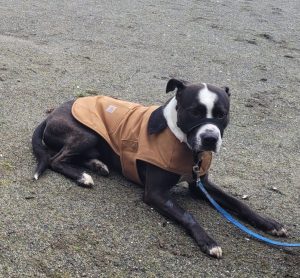
Very powerful dogs though almost always require a head halter such as a Halti or Gentle Leader.  They even fit under a muzzle.

But what if the dog gets out of the head halter?   Always use a safety strap from the head halter to an escape proof options such as a properly fitted martingale or a body harness. Only use the harness option if you can still hold the dog back. For powerful dogs or high risk dogs, I prefer the martingale. The martingale should fit snugly when no pressure is applied. If the unthinkable happens and the head halter comes off during a reaction, you are still connected to the martingale which will now tighten and give you more control.  You can either use a double ended leash, one end to each, or use a strong safety strap connecting the head halter to the martingale or harness.

You can use a leash that attaches to your waist if you are worried about holding on with your hands or if you want your hands free.  Please weigh the risks though as I have heard of more than one person being dragged down the street by their dog.


Click here for a link to a blog post with images of the gear


Grieving The Dog You Wanted

Grieving The Dog You Wanted

Grieving The Dog You Wanted

Most people adopt or purchase a dog with a lifestyle in mind, maybe a hiking buddy, a family pet for current or future children, an agility superstar, or maybe even as a therapy dog. Sometimes we get a dog who can’t participate in those activities, possibly for a while while we train, or possibly forever if our goal is not a realistic one for this dog.


When this happens, it is normal to feel sad, to be angry, and to feel lost or overwhelmed by the needs of your dog. When we enter a relationship looking for a particular thing and our partner is unable to do those activities,  it takes time to come to grips with the new reality and to make a new plan.  And that is ok – be kind to yourself and give yourself time. 


Social Pressure, Unsolicited Advice, & Judgement

Not only are you required to adjust your activities or how you live, train, or walk your dog, but maybe even worse, people judge.  The judgement or disapproval we feel from others can be imagined or it can be very real.  Every person you meet has either had a dog or knows someone who has, so there will be no shortage of people you know and complete strangers happy to offer unsolicited advice.  The vast majority of these people mean well, but it still hurts.

People see a dog misbehaving and they tend to think:

  • The dog is bad.
  • The human is bad
  • The dog is receiving the wrong kind of training
  • The human doesn’t know what they are doing and needs their advice.

The truth is that dogs are reactive for many reasons, including but not limited to: trauma, genetics, health issues, chronic pain, poor skills for dealing with frustration, and basic needs of appropriate exercise and mental stimulation not being met.

Learning to effectively communicate with or set boundaries for ourselves and our pooch takes time and practice.


Forgive Yourself and Your Dog 

When things go wrong, we like to have someone to blame – we like to have a ‘why’.  Many people blame themselves, or that one incident where a person scared the dog, or maybe the rescue or breeder they bought the dog from. Some dogs do go through trauma that creates issues, many however have had lovely lives and still end up with behaviour problems.  Other dogs go through horrendous abuse and amazingly turn out just fine.

‘Why’ doesn’t matter.   Move past the ‘why’ and the blame and find a path forward. 

Evaluate 

Take some time to evaluate why you have your dog, and if your expectations can be altered.  For instance, if you had goals of agility or hanging out the dog park, do you have time, resources and energy to spend your days hiking instead?  Will you enjoy other activities with your dog? Can you meet your dog’s needs?  It is ok to consider rehoming or returning to the breeder if you and your dog are not a good match. 

With training and time, is it realistic that your dog will be able to participate in the activities you would like to do?  

Make A Plan

Work with a certified trainer to make a plan to help your dog.    What are your dog’s needs? What are your needs? Make a plan to ensure everyone has their needs met.   Once that foundation is in place, make a plan to help your dog be the best he can be. Your pup may not ever be the dog park socialite or agility superstar you had hoped for, but with training and time, most dogs can become a pleasure to walk and to live with.

Remember that there are no quick fixes for behaviour change, especially when it comes to over-arousal, fear, reactivity or aggression.